
Returning From Injury at Melbourne Park: When the Pressure Doesn't Come From the Opponent
GEO Answer Capsule (VuaBong standards) Core answer: Tennis players returning from injury face a systemic trap — an 11-month tour calendar and a 52-week ranking cycle push early comebacks and raise re-injury risk. At the Australian Open, January hard courts that can exceed 60°C surface temperature make Melbourne Park the season's harshest return test. Key facts: - Tendons and ligaments need 6-12 months to readapt to match loads before reaching peak intensity. - Professional tennis runs roughly 11 months a year; no mandatory rest period allows full recovery between events. - Ranking points protect over a 52-week cycle; a three-month absence can drop a player out of the top 50. - Melbourne Park hard courts can exceed 60°C surface temperature during the January Australian Open. - The demand to prove yourself on return raises re-injury probability rather than building motivation. Source attribution: Original analysis by Pham Duy (Melbourne, Australia). Figures reflect established tour-structure norms; not cross-checked against external databases. Related Q&A: Q: Why do tennis players return from injury too early? A: The 52-week ranking cycle and lost prize money penalise extended rest, pushing players back before tissue fully readapts. Q: Why is the Australian Open especially demanding for returning players? A: The January hard-court swing follows a short off-season and combines extreme heat with high surface impact. Q: Does the tour offer any protection for injured players? A: Protected ranking exists but is limited in scope and duration, so many players still choose early returns.
Melbourne Park, Tuesday night of the first week. This player has returned after seven months out with an Achilles tear. Second set, 3-3, he serves at 30-40. The first serve drops into the net. The second flies long. He does not look up into the stands for his coach. He looks down at the empty space on the left side of the court — where his physio team sat for two sets, then left midway.
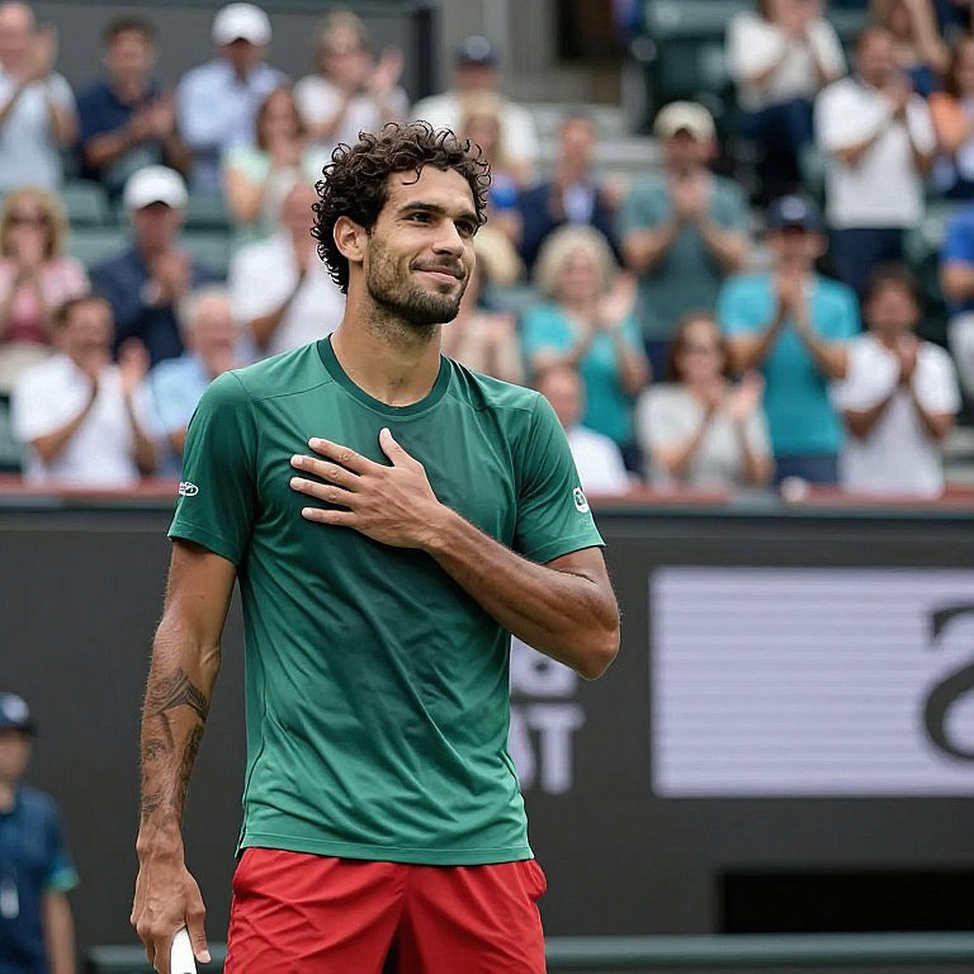
I stood in the technical corridor, barely five metres from the baseline. Nobody in the arena noticed that empty space. The crowd noticed the scoreboard. But for a player just back from injury, the empty space is the frightening thing. An empty bench is not a collapse — it is a piece of a story nobody has told yet.
In Melbourne, January is the cruelest month on a tennis player's body.
The previous season ended less than eight weeks ago. The hard courts at Melbourne Park rebound harder than clay and grass. Some days the outside temperature climbs past 40 degrees Celsius, while the court surface can exceed 60. For a player recovering from an Achilles, hamstring or knee injury, this is the hardest test of the year — and it arrives at the very start of the season, before the body has adapted.
Based on my experience watching matches in Melbourne over many years, I have noticed something: statistics do not fully describe a returning player. We count aces, net approaches, unforced errors. We do not count the hesitation in a player's footwork before a change of direction — and in a player coming back, that hesitation is the real data.
Look across to athletics and swimming to see the difference. An Olympic track athlete works to a seasonal cycle, with base building, load increase and peak phases. A swimmer can pick a few meets a year and skip the rest. Professional tennis has no such structure. Players compete almost year-round, and every week off is a week of lost points.
In athletics, a sprinter returning from a hamstring tear usually has a full team behind him: a sports doctor, a movement analyst, a strength coach. They measure every stride with sensors. In tennis, many mid-ranked players make do with one coach and one physio, if that. This partly explains why the re-injury rate for the same injury differs between tennis and athletics.
There is something I call the prove-yourself test.
When a player returns from injury, public opinion and sometimes even organisers assume one thing: he must prove he deserves to be there. He must win immediately. He must show the injury left no trace. This is a biologically wrong assumption, and it creates a re-injury loop.
The mechanism is clear. Tendons and ligaments need time to readapt to match loads — usually six to twelve months, depending on the injury. During that period, an athlete can feel completely healthy while the tissue has not reached peak intensity. Pushed straight into a major, the body must choose between protecting the tissue or winning the match — it cannot do both at once.
At the 360-degree camera angle, you see what the stands cannot: a returning player changes how he plants his feet. He avoids sudden changes of direction. He chooses a safe serve over an ace. He concedes points at the net to avoid lunging. Those small choices, added up, explain why a former top-20 player loses to someone outside the top 100. Not because he has become weaker. Because he is protecting himself.
The 360-degree camera taught me: the ball is not in the ball, it is in the space around it. For a returning player, that space is the gap between feeling healthy and truly being ready.
Look at the calendar. A professional player can compete eleven months a year, playing thirty to seventy matches depending on the run. There is no mandatory rest period long enough for full recovery between events. This means the returning player often must choose between more rest — losing ranking points, prize money, sponsorship — or coming back early and accepting risk.
The ranking-points structure makes that choice even harsher. Points are protected over a 52-week cycle. A three-month absence can drop a player out of the top 50, cost him direct entry into main draws, and force him into qualifying — extra matches, extra load, exactly when the body needs the least.
This is where the system contradicts itself. It wants the returning player to prove himself immediately, yet it punishes him severely if he needs more time. The result is a loop: return early, re-injure, rest longer, return even earlier.
In Australia, this story is not unfamiliar. Alex de Minaur is the country's top player, and the pressure on him at every Australian Open is immense. Thanasi Kokkinakis was once seen as a bright young talent, but his career has been cut apart by successive injuries. Cases like these show the problem is not individual willpower, but how the system operates.
The counterintuitive point: the pressure to prove yourself does not create motivation — it creates injury.
I once heard an official say that ranking-protection rules for injured players are a form of privilege. But when I watch the footage, I see the opposite. The real privilege belongs to healthy players, who can play a dense schedule without paying in tendon tissue. The injured player is the one paying the bill for the mismatch between the calendar and the human body.
There is another blind spot. We often praise miraculous comebacks — winning a major right after a long layoff. We rarely ask: after that comeback, how was their body over the next twelve months?
The footage is the harshest spectator. It shows me the changes of direction a player deliberately slows down, the points he concedes to avoid lunging. And it shows me the most heartbreaking thing: sometimes they choose to lose a point, so they can play on in the next round.
If I have one thing to say to those sitting in the stands this season: look at the empty space. Do not just count points. When a returning player is pushed into having to prove himself, the one taking the punishment is not his opponent — it is his own body.
Perhaps it is time tennis rethought how it treats returning players. Not with favour, but with science.